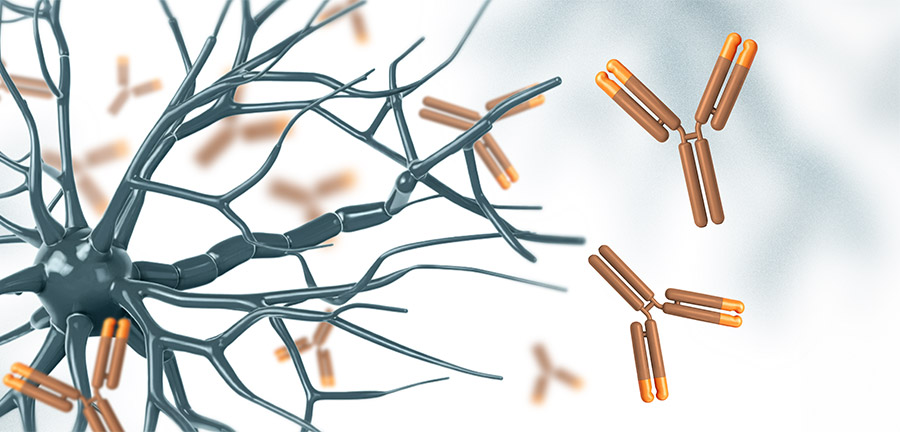
Engineering monoclonal antibodies to help veterinarians deliver precision care
Scientists deploy a meticulous approach to discover, develop and manufacture innovative mAbs that target disease and help pets live healthier lives.
This audio recording was enabled by AI
Key Points
- Precision therapies are reshaping veterinary care, with species-specific monoclonal antibodies (mAbs) enabling targeted, longer-acting treatments for chronic diseases in dogs and cats.
- Scientific rigor across the lifecycle—from discovery through manufacturing—ensures mAbs function like natural antibodies while meeting high standards for safety, efficacy, and consistency.
- Zoetis’ scale, expertise, and global infrastructure turn cutting-edge antibody science into trusted, widely available solutions for veterinarians and pet owners.
Zoetis scientists recognize the life-changing potential of therapies like monoclonal antibodies (mAbs) that could target chronic diseases in dogs and cats.
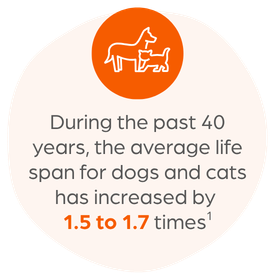
Innovations like mAbs are especially important during this pivotal time in veterinary medicine. Pets are living longer than ever before. During the past 40 years, the average lifespan for dogs and cats has increased by 1.5 to 1.7 times. As more pets enter their senior years, they also may experience more complex conditions.1
Scientists are making significant progress developing mAbs that address unmet needs in chronic conditions. Along the journey, they are helping veterinarians understand the meticulous science behind therapeutic mAb discovery– and how these new tools can revolutionize pet care.
Monoclonal antibody fundamentals: how antibodies target disease in pets
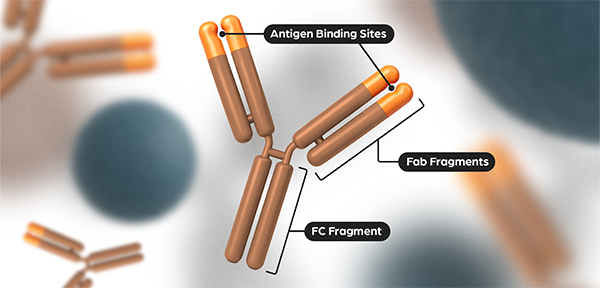
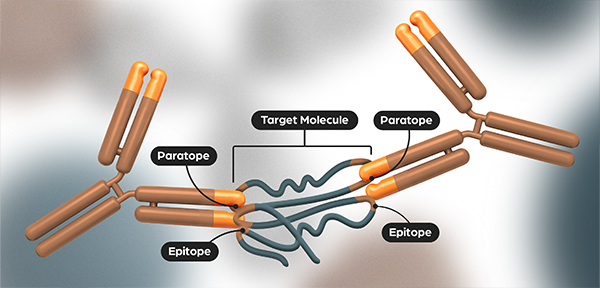
Like humans, pets have antibodies that help them fight disease. Antibodies are Y-shaped, and at the top of the “Y” are Fab fragments that resemble ‘the fingers’ – they target and bind to a small section of the antigen known as epitopes, and the epitopes can vary widely for each unique antibody. This binding interaction can neutralize the antigen directly and/or send a signal to the animal’s immune system to neutralize or destroy the antigen.
But one of the challenges in engineering antibody solutions is that antibodies are different for each species. Scientists have to understand what those variations look like across species for the antibody, but also how each protein behaves and functions in each species so that the mAbs being developed will bind with the right target, neutralize the right interactions, and mimic the natural properties of antibodies in the patient.
Work cited as foundational to understanding both canine and feline IgGs2 describes the functional characteristics and sequence variations of antibody isotypes across species. These individual antibody traits determine how each new therapy will be engineered for the ideal functionality in vivo.
This carefully orchestrated approach aims to provide “precise treatment with potentially fewer side effects than traditional therapies,” said Matheus Sathler, Senior Principal Scientist in Zoetis’ R&D organization.
Inside our rigorous monoclonal antibody development for pets
The goal when creating a new mAb is to make it specific to the correct target and epitope and that it looks and feels like a natural antibody of the animal. Scientists use multiple platforms and technologies to help develop mAb therapies – which is important because each discovery platform offers its own unique advantages based on the target. It’s a bit like panning for gold, except the ‘gold’ also must be functional, stable, manufacturable and the right fit for the species. If needed, scientists can tailor the mAb to further meet their needs, but the use of the right technologies and the understanding of veterinary antibodies upfront are critical to getting to the right starting point for each new mAb.
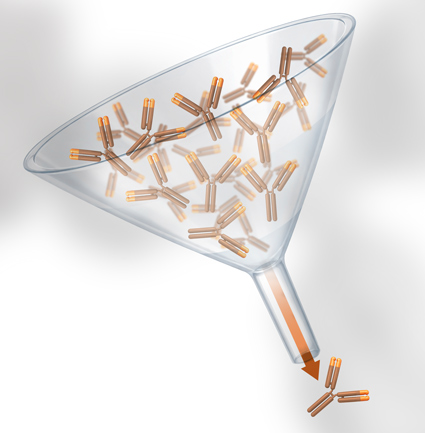
For example, scientists can generate mAbs using in vitro display technologies, searching billions of unique species-specific antibody fragments to find a match that binds to the target. That match can then be engineered and optimized into a therapy. Other approaches are used to isolate single, antibody-producing cells, which are nature’s own experts at making a specific antibody, and then scientists can replicate their design. Furthermore, antibody sequences can be modified from one species to another through techniques referred to as ‘speciation,’ an approach enhanced by recent advancements in protein modeling and prediction tools. These combined unique strategies ensure experts start with the best possible candidates for developing a new therapy.
Once a structure is created, scientists analyze each mAb in the lab and look for a variety of characteristics. “We have in vivo and in vitro teams working to evaluate and validate every potential therapy. We start with hundreds of mAbs and go through a rigorous process to narrow them down to the right ones,” said Matheus.
For example, scientists conduct tests to determine the mAb’s affinity or ability to bind tightly and specifically to the target. “We know small molecules can be promiscuous and bind to unintentional targets, sometimes resulting in side effects,” said Matheus. “We test our mAbs to ensure they bind to the precise target in the dog or cat’s unique biology.”
Throughout the disciplined development journey, scientists glean insights from Zoetis’ vast database of studies related to dogs and cats to yield a “holistic view of the animal,” said Matheus. “We look at how diseases fluctuate over time and how proteins behave and change and how that behavior relates to disease. This knowledge enables us to design therapies specifically for the species they serve, optimizing compatibility and efficacy while minimizing unintended reactions.”
Manufacturing quality veterinary monoclonal antibodies at scale
Engineering quality mAbs is one hurdle; another is being able to scale up for commercialization and consistently manufacture the mAbs. “We conduct developability assessments to help select the best candidate – not just the most potent,” said Jaspreet Vasir, Senior Director whose team develops manufacturing processes for mAbs and transfers them to commercial manufacturing facilities at Zoetis. “We evaluate multiple mAb candidates for expression and stability, chemical liabilities, solubility, alongside early purification feasibility to find a mAb that meets the criteria for efficacy, safety, product stability and manufacturability aspects.”
Once a final mAb candidate is identified, development focuses on first creating and selecting a high‑producing, stable cell line to produce the mAb. Upstream cell culture conditions are developed with well-defined media/feed strategy, and critical process setpoints like pH/DO/temperature. mAb therapeutics are then purified using downstream processes to remove cellular contaminants and to meet quality targets. In parallel, teams develop formulation composition to maintain mAb stability through storage, shipment and delivery. Throughout development, analytical methods and characterization tools are used to track mAb quality/structure, biological activity and product stability, forming the foundation of the control strategy for commercial manufacturing.
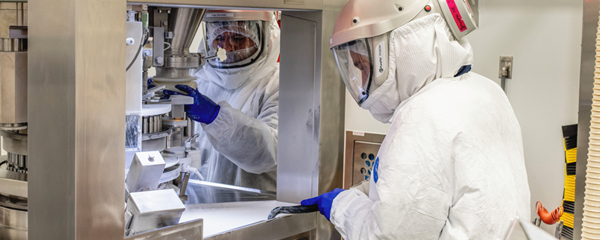
During process development, teams use small‑scale, scale‑down models and statistical design‑of‑experiments to identify critical process parameters and establish a control strategy that consistently delivers the desired quality attributes. Scale‑up to commercial manufacturing then translates this well characterized process into large scale bioreactors by maintaining appropriate engineering similarity (e.g., mixing kinetics/oxygen transfer, hold times), followed by larger purification and filtration trains, while adding robust in‑process controls to ensure the process is reproducible, and delivers the same product quality at commercial scale. This rigorous approach is executed all over the world at Zoetis manufacturing facilities in Lincoln, Nebraska, Belgium, and Ireland—with a new site in Atlanta, Georgia planned to be operational by 2029.
“Over the past 15 years, Zoetis has attracted top talent across fermentation, biochemistry, molecular biology and chemical engineering. Combined with sustained investment in state‑of‑the‑art technology, that scientific expertise has helped us bring innovative mAb therapies to customers around the world,” said Jaspreet, who joined the Zoetis R&D division 18 years ago. “I am proud of our team of scientists who are deeply committed to producing safe, effective and high-quality mAbs so that we earn the trust of veterinarians and pet owners.”
Science-driven innovation: ensuring quality, safety, and consistency
Regardless of the complex challenges scientists are up against when creating and manufacturing much-needed, quality mAbs, Zoetis scientists “have a work-until-you-get-it-right mindset,” said Matheus.
“This commitment stems from the fact that we create therapies that go into someone’s dog or cat. We develop our mAbs with the highest safety standards, using full-spectrum science and global clinical data. Veterinarians want efficacious and safe products, and that happens with scientific rigor.”
Matheus Sathler, Senior Principal Scientist in Zoetis’ R&D organization
With that rigor and determination comes a deep sense of purpose. “Many of our scientists at Zoetis are pet owners too,” said Jaspreet, who recently welcomed a mixed-breed rescue puppy named Rani into her family. “She brings us so much joy, and we want her to have the best quality of life possible. That’s what drives my work – helping make that possible for Rani, and for dogs and cats around the world.”
Updated on June 24, 2026
All trademarks are the property of Zoetis Services LLC or a related company or a licensor unless otherwise noted. © 2026 Zoetis Services LLC. All rights reserved. NA-04378
References
1 How can we achieve more accurate reporting of average dog lifespan? | Journal of the American Veterinary Medical Association Volume 262 Issue 9 (2024), PubMed: “Life expectancy tables for dogs and cats derived from clinical data”, AVMA Journal: “Study of the feline and canine populations in the Greater Las Vegas area”, PubMed: “Life tables of annual life expectancy and risk factors for mortality in cats in the U.K.”, U.S. Veterinary Teaching Hospitals, U.S. Banfield Pet Hospitals, U.S. Veterinary Teaching Hospital, U.S. Banfield Pet Hospitals, Kynetec, U.S. June 2025 MAT.
2 Bergeron LM, McCandless EE, Dunham S, Dunkle B, Zhu Y, Shelly J, Lightle S, Gonzales A, Bainbridge G. Comparative functional characterization of canine IgG subclasses. Vet Immunol Immunopathol. 2014 Jan 15;157(1-2):31-41. doi: 10.1016/j.vetimm.2013.10.018. Epub 2013 Nov 1. PMID: 24268690; Steiniger SC, Dunkle WE, Bammert GF, Wilson TL, Krishnan A, Dunham SA, Ippolito GC, Bainbridge G. Fundamental characteristics of the expressed immunoglobulin VH and VL repertoire in different canine breeds in comparison with those of humans and mice. Mol Immunol. 2014 May;59(1):71-8. doi: 10.1016/j.molimm.2014.01.010. Epub 2014 Feb 4. PMID: 24509215; Steiniger SC, Glanville J, Harris DW, Wilson TL, Ippolito GC, Dunham SA. Comparative analysis of the feline immunoglobulin repertoire. Biologicals. 2017 Mar;46:81-87. doi: 10.1016/j.biologicals.2017.01.004. Epub 2017 Jan 26. PMID: 28131552; Strietzel CJ, Bergeron LM, Oliphant T, Mutchler VT, Choromanski LJ, Bainbridge G. In vitro functional characterization of feline IgGs. Vet Immunol Immunopathol. 2014 Apr 15;158(3-4):214-23. doi: 10.1016/j.vetimm.2014.01.012. Epub 2014 Feb 5. PMID: 24560097.